
15 SEO Mistakes That Are Killing Your Website Rankings in 2026
Search engine optimization is changing fast. In 2026, ranking on Google alone is no longer enough. Your content also needs to perform well on AI-powered search platforms.
SEO
5/14/20264 min read
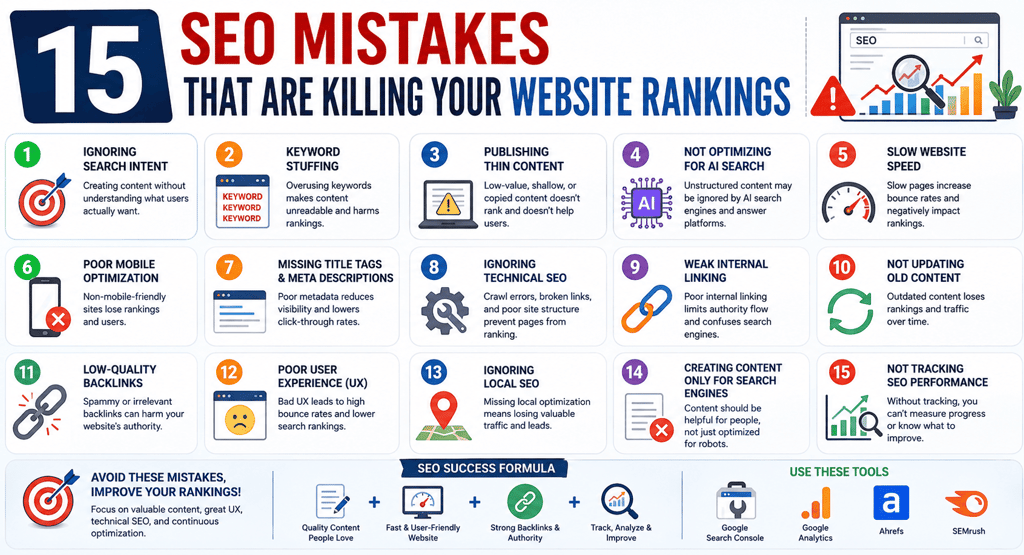
15 SEO Mistakes That Are Killing Your Website Rankings
Search engine optimization is changing fast. In 2026, ranking on Google alone is no longer enough. Your content also needs to perform well on AI-powered search platforms like ChatGPT
Perplexity AI
Google Gemini
Claude AI
and Microsoft Copilot
Many websites lose rankings not because of competition, but because of avoidable SEO mistakes. Even a well-designed website can struggle if it ignores technical SEO, content quality, user experience, or AI search optimization.
In this guide, you’ll learn the 15 most common SEO mistakes that are hurting website rankings and how to fix them.
1. Ignoring Search Intent
One of the biggest SEO mistakes is creating content without understanding what users actually want.
If someone searches for:
“Best SEO tools” → they want recommendations
“How to do SEO” → they want a tutorial
“SEO agency near me” → they want a service provider
Many websites target keywords but fail to match the user’s intent.
How to Fix It
Analyze top-ranking pages before writing content
Understand whether the query is informational, transactional, or navigational
Create content that directly answers the search query
Use clear headings and concise explanations
AI search engines especially prioritize content that provides direct and useful answers.
2. Keyword Stuffing
Repeating the same keyword dozens of times no longer works.
Google’s algorithms and AI answer engines understand context and semantic meaning. Overusing keywords makes content unreadable and may reduce trust signals.
Bad Example
“Best SEO company offers best SEO services for businesses looking for best SEO company solutions.”
Better Approach
Use:
Related keywords
Natural language
Synonyms
Topic clusters
Focus on readability first.
3. Publishing Thin Content
Thin content means pages with little value, shallow information, or copied ideas.
Examples:
300-word blog posts with no insights
AI-generated articles without editing
Duplicate service pages
Empty category pages
Search engines reward depth, expertise, and originality.
How to Fix It
Create:
Comprehensive guides
Case studies
Step-by-step tutorials
Original research
FAQs
Expert insights
Long-form informative content generally performs better in both traditional and AI search results.
4. Not Optimizing for AI Search Engines
Modern SEO is not only about ranking on Google.
AI platforms now summarize content directly in search results. If your content is not structured properly, AI systems may ignore it.
AI SEO Best Practices
Use question-based headings
Write concise answers
Add FAQ sections
Use structured formatting
Include statistics and examples
Build topical authority
Content optimized for answer engines has a better chance of appearing in AI-generated responses.
5. Slow Website Speed
A slow website increases bounce rates and hurts user experience.
Google uses Core Web Vitals as ranking signals, and users expect pages to load quickly.
Common Causes:
Large images
Cheap hosting
Excessive plugins
Unoptimized code
No caching
How to Fix It:
Compress images
Use fast hosting
Enable caching
Minify CSS and JavaScript
Use a CDN
Fast websites improve rankings, conversions, and engagement.
6. Poor Mobile Optimization
Most searches now happen on mobile devices.
If your website is difficult to use on smartphones, rankings can suffer significantly.
Mobile SEO Checklist
Responsive design
Fast mobile loading speed
Readable fonts
Easy navigation
Clickable buttons
Optimized images
Google primarily uses mobile-first indexing, meaning it evaluates the mobile version of your site first.
7. Missing Title Tags and Meta Descriptions
Your title tag and meta description influence both rankings and click-through rates.
Poorly optimized metadata reduces visibility in search results.
Best Practices
Title Tag
Include the primary keyword
Keep it under 60 characters
Make it compelling
Meta Description
Summarize the page clearly
Add a call-to-action
Keep it under 160 characters
Example:
Title: 15 SEO Mistakes That Hurt Rankings in 2026
Meta Description: Discover the biggest SEO mistakes affecting your website traffic and learn how to improve rankings on Google and AI search engines.
8. Ignoring Technical SEO
Technical SEO helps search engines crawl and index your website properly.
Even high-quality content may not rank if technical issues exist.
Common Technical SEO Problems
Broken links
Crawl errors
Duplicate pages
Missing XML sitemap
Incorrect robots.txt configuration
Poor URL structure
Recommended Actions
Perform regular SEO audits
Fix crawl issues
Use clean URLs
Submit XML sitemaps
Improve site architecture
9. Weak Internal Linking
Internal links help search engines understand your website structure and distribute authority across pages.
Many websites either ignore internal linking or overdo it.
Internal Linking Tips
Link relevant pages naturally
Use descriptive anchor text
Connect blog posts to service pages
Create topic clusters
Strong internal linking improves crawling and user engagement.
10. Not Updating Old Content
Outdated content loses rankings over time.
Search engines prefer fresh and updated information, especially in competitive industries.
Update Strategy
Refresh statistics
Add new examples
Improve readability
Update screenshots
Add recent trends
Expand weak sections
Content updates can significantly increase organic traffic.
11. Low-Quality Backlinks
Not all backlinks help SEO.
Spammy backlinks from irrelevant websites can damage trust and authority.
Avoid
Paid spam links
Link farms
Automated backlinks
Irrelevant directories
Focus On
Guest posting
Digital PR
Industry mentions
High-authority websites
Valuable content that earns links naturally
Quality matters more than quantity.
12. Poor User Experience (UX)
Google increasingly measures how users interact with websites.
If users quickly leave your page, rankings may decline.
UX Issues That Hurt SEO
Intrusive popups
Confusing navigation
Too many ads
Poor readability
Cluttered layouts
Improve UX By
Using clean designs
Adding whitespace
Improving navigation
Making content scannable
Using headings and bullet points
A good user experience improves both SEO and conversions.
13. Ignoring Local SEO
Businesses targeting local customers often forget to optimize for local searches.
This leads to lost traffic and missed leads.
Local SEO Tips
Optimize your Google Business Profile
Add location-based keywords
Get customer reviews
Build local citations
Use consistent NAP information
Local SEO is essential for businesses serving specific cities or regions.
14. Creating Content Only for Search Engines
Some websites focus so much on rankings that they forget real people are reading the content.
Search engines now prioritize:
Helpful content
Expertise
User satisfaction
Authenticity
Best Approach
Write for humans first and optimize for search engines second.
Content should:
Solve problems
Answer questions
Be easy to understand
Offer genuine value
Human-focused content performs better across both traditional and AI search platforms.
15. Not Tracking SEO Performance
Without tracking results, you won’t know what is working.
SEO requires continuous monitoring and optimization.
Important Metrics to Track
Organic traffic
Keyword rankings
Bounce rate
Click-through rate
Conversion rate
Indexed pages
Backlinks
Recommended Tools
Google Search Console
Google Analytics
Ahrefs
SEMrush
Regular SEO audits help identify issues before rankings drop.
Final Thoughts
SEO in 2026 is about more than keywords and backlinks. Search engines and AI platforms now prioritize:
Helpful content
User experience
Technical performance
Content accuracy
Structured information
Authority and trust
Avoiding these 15 SEO mistakes can improve your visibility across Google, Bing, Yahoo, and AI-powered search engines.
If you want long-term SEO success, focus on creating valuable, user-first content while maintaining strong technical optimization and AI search readiness.
The websites that adapt to modern SEO and AI search trends today will dominate search rankings tomorrow. Contact us for more information.
Get in touch
Location
Odhav, Ahmedabad, 382415
Gujarat, India
© 2025. All rights reserved. Pro Digital Marketing Service