
How to Rank Your Website Faster with Smart SEO Strategies
Learn smart SEO strategies to rank your website faster in 2026. Discover AI SEO tips, technical SEO, content optimization, backlinks, and ranking techniques for Google and AI search engines.
SEO
5/15/20264 min read
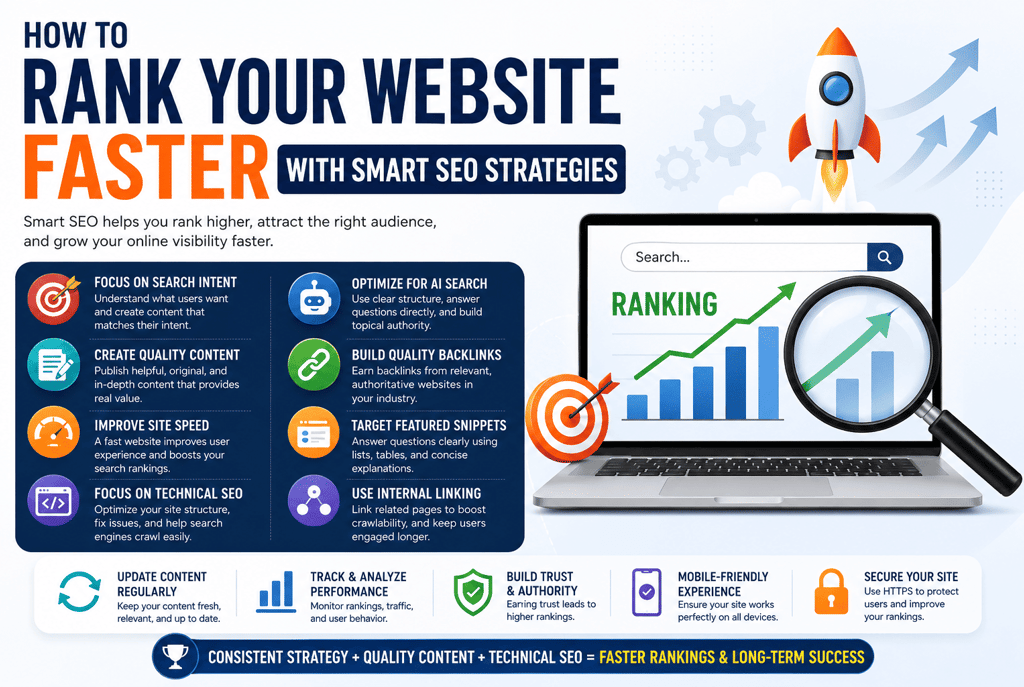
How to Rank Your Website Faster with Smart SEO Strategies
Getting your website to rank on Google is no longer just about adding keywords and building a few backlinks. Search engines and AI-powered answer platforms now focus heavily on user intent, content quality, experience, trust, and relevance. Whether someone searches on Google, Bing, Yahoo, ChatGPT, Perplexity, Gemini, Claude, or Microsoft Copilot, the goal remains the same: provide the best and most accurate answer.
If you want faster rankings in 2026, you need smarter SEO strategies that combine traditional SEO with AI search optimization. In this guide, you will learn practical techniques that help websites rank faster, attract qualified traffic, and build long-term online visibility.
1. Start with Search Intent, Not Just Keywords
One of the biggest SEO mistakes is targeting keywords without understanding what users actually want.
Modern search engines analyze the intent behind every query. Before creating content, ask:
Is the user looking for information?
Do they want to buy something?
Are they comparing services?
Are they searching for a local business?
For example, the keyword “best SEO tools” has commercial intent, while “how SEO works” has informational intent.
When your content matches the user’s intent perfectly, search engines reward it with better rankings.
Smart Tip:
Use primary keywords naturally and include related semantic terms throughout the content. AI search engines understand context better than exact-match repetition.
2. Create High-Quality, Helpful Content
Content remains the foundation of SEO success. However, search engines now prioritize helpful and experience-based content over generic AI-generated articles.
To rank faster:
Write detailed and actionable content
Answer real user questions
Add examples and practical insights
Use short paragraphs for readability
Include headings and subheadings
Keep the content updated regularly
Your content should solve a problem better than competing pages.
What Works Best in 2026:
Step-by-step guides
Expert tutorials
Case studies
Comparison articles
FAQs
Industry insights
Data-backed content
Long-form content generally performs better because it covers topics comprehensively and increases user engagement.
3. Optimize for AI Search Engines and Answer Platforms
AI-powered search platforms are changing how people discover websites. Platforms like ChatGPT, Perplexity, Gemini, Claude, and Copilot often summarize information directly from authoritative content sources.
To improve visibility on AI search engines:
Use Clear Content Structure
AI systems prefer content that is easy to understand.
Use:
H1, H2, and H3 headings
Bullet points
Numbered lists
Simple explanations
FAQ sections
Answer Questions Directly
Include concise answers near the beginning of sections. This improves your chances of appearing in featured snippets and AI-generated responses.
Build Topical Authority
Instead of publishing random blogs, create topic clusters around your niche.
Example:
If your niche is digital marketing, publish interconnected content about:
SEO
Google Ads
Social Media Marketing
Technical SEO
Local SEO
AI SEO
This helps search engines understand your expertise.
4. Improve Website Speed and User Experience
A slow website can hurt rankings significantly.
Google and Bing prioritize websites that provide a smooth user experience across all devices.
Important SEO Performance Factors:
Fast loading speed
Mobile-friendly design
Secure HTTPS connection
Easy navigation
Clean URL structure
Low bounce rate
Ways to Improve Speed:
Compress images
Use caching plugins
Minify CSS and JavaScript
Use a reliable hosting provider
Enable lazy loading
A faster website improves both rankings and conversions.
5. Focus on Technical SEO
Technical SEO helps search engines crawl and index your website correctly.
Even excellent content may struggle to rank if technical issues exist.
Essential Technical SEO Checklist:
Submit XML sitemap
Fix broken links
Optimize robots.txt
Use schema markup
Improve Core Web Vitals
Add canonical tags
Fix duplicate content
Create SEO-friendly URLs
Schema markup is especially important because it helps search engines understand your content better and increases visibility in rich results.
6. Build High-Quality Backlinks
Backlinks remain one of Google’s strongest ranking signals.
However, quality matters far more than quantity.
Smart Link Building Strategies:
Guest posting on relevant websites
Creating shareable content
Publishing original research
Building partnerships
Getting listed in industry directories
Digital PR campaigns
Avoid spammy backlinks or low-quality link farms. Search engines are now better at identifying unnatural link patterns.
One backlink from an authoritative website can be more valuable than hundreds of weak links.
7. Optimize for Featured Snippets
Featured snippets help websites gain massive visibility quickly.
These are the highlighted answers shown at the top of Google search results.
To Increase Snippet Chances:
Answer questions clearly
Use bullet points and tables
Add concise definitions
Structure content properly
Include FAQ sections
Example:
Instead of writing a long paragraph first, directly answer the question in 40 to 60 words before expanding further.
This strategy also improves visibility on AI-powered answer engines.
8. Use Internal Linking Strategically
Internal links help search engines understand your website structure and distribute authority between pages.
Benefits of Internal Linking:
Improves crawlability
Increases page authority
Keeps users on the site longer
Helps related pages rank faster
Link related blog posts naturally within your content.
For example:
A blog about “SEO Strategies” can internally link to:
Technical SEO Guide
Keyword Research Tips
Local SEO Checklist
Google Ads vs SEO
This creates a strong content ecosystem.
9. Update Existing Content Regularly
Fresh content often ranks faster than outdated pages.
Instead of always creating new posts, improve older content by:
Adding updated statistics
Refreshing screenshots
Improving readability
Expanding sections
Adding new keywords
Updating titles and meta descriptions
Google prefers content that stays accurate and relevant.
Regular updates can significantly improve rankings without publishing new pages.
10. Track SEO Performance and Adapt
SEO is constantly evolving. What works today may change tomorrow.
Use tools like:
Google Search Console
Google Analytics
Bing Webmaster Tools
Ahrefs
SEMrush
Monitor:
Organic traffic
Keyword rankings
Click-through rate
Bounce rate
Indexed pages
Backlink growth
Data-driven SEO decisions lead to faster growth and better long-term performance.
Final Thoughts:
Ranking a website faster in 2026 requires a combination of smart SEO, user-focused content, technical optimization, and AI search visibility strategies.
Search engines are becoming more intelligent, and AI-powered platforms are changing how users discover information online. Websites that provide accurate, trustworthy, and well-structured content will continue to dominate search results.
Focus on creating genuinely helpful content, improving user experience, optimizing technical SEO, and building authority within your niche. When combined consistently, these smart SEO strategies can significantly accelerate your website’s rankings and organic traffic growth.
Get in touch
Location
Odhav, Ahmedabad, 382415
Gujarat, India
© 2025. All rights reserved. Pro Digital Marketing Service