The Complete On-Page SEO Checklist for Higher Google Rankings
If your website is not appearing on Google’s first page, improving your on-page SEO can make a major difference.
SEO
6/22/20263 min read
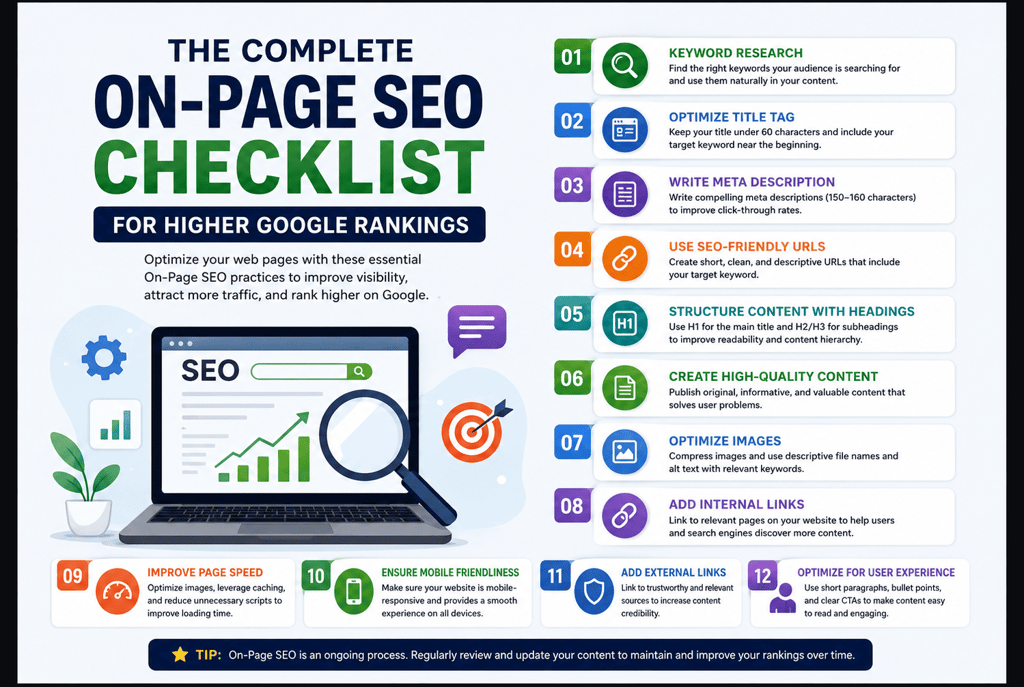
If your website is not appearing on Google’s first page, improving your on-page SEO can make a major difference. On-page SEO focuses on optimizing individual web pages so search engines can better understand your content and rank it higher. It also improves user experience, which plays an important role in SEO success...
Here is the complete on-page SEO checklist to help improve your website rankings.
1. Start with Keyword Research
Before creating content, identify the right keywords your audience is searching for. Use a primary keyword naturally throughout the page and include related keywords where relevant. Avoid keyword stuffing because it can negatively impact readability and rankings.
2. Optimize the Title Tag
Your title tag is one of the strongest ranking signals. Keep it under 60 characters and include your target keyword near the beginning.
Example:
The Complete On-Page SEO Checklist for Higher Google Rankings
3. Write a Compelling Meta Description
Although meta descriptions do not directly affect rankings, they improve click-through rates. Keep descriptions between 150 to 160 characters and make them engaging.
4. Use SEO-Friendly URLs
Short, clear URLs help both users and search engines.
Good Example:
yourwebsite.com/on-page-seo-checklist
Avoid long URLs with unnecessary words or numbers.
5. Structure Content with Headings
Use H1 for the page title and H2/H3 tags to organize sections. Proper heading structure improves readability and helps search engines understand content hierarchy.
6. Create High-Quality Content
Content should solve user problems and provide value. Focus on writing original, informative, and easy-to-read content instead of creating pages only for search engines.
7. Optimize Images
Compress images to improve loading speed and add descriptive file names and alt text containing relevant keywords where appropriate.
8. Add Internal Links
Link to related pages within your website. Internal linking helps visitors explore more content and allows search engines to crawl pages more effectively.
9. Improve Page Speed
Fast-loading websites improve user experience and reduce bounce rates. Optimize images, enable caching, and minimize unnecessary scripts.
10. Ensure Mobile Friendliness
Most users browse on mobile devices. Your website should display properly across all screen sizes.
11. Add External Links When Useful
Linking to trustworthy and relevant sources can improve content credibility.
12. Optimize for User Experience
Make content easy to scan with short paragraphs, bullet points, and clear calls to action.
Final Thoughts:
On-page SEO is not a one-time task. Regular updates, content improvements, and technical SEO optimization help maintain and improve rankings over time. Follow this checklist consistently to build a stronger website presence and increase your chances of ranking higher on Google.
Contact us for Free Website SEO Audit
FAQs
1. What is On-Page SEO?
On-page SEO is the process of optimizing individual website pages to improve search engine rankings and provide a better user experience. It includes optimizing content, titles, headings, images, URLs, and internal links.
2. Why is On-Page SEO important for Google rankings?
On-page SEO helps search engines understand your content and determine its relevance to user searches, increasing the chances of ranking higher in search results.
3. How often should I update my On-Page SEO?
You should review and update your on-page SEO regularly, especially when publishing new content, changing target keywords, or updating website design and structure.
4. What is the ideal length for a meta description?
A meta description should generally be between 150 and 160 characters to ensure it displays properly in search results.
5. Does page speed affect SEO rankings?
Yes, page speed is an important ranking factor. Faster websites improve user experience and can help reduce bounce rates.
6. How many keywords should I use on one page?
Focus on one primary keyword and include related keywords naturally throughout the content. Avoid excessive keyword usage.
7. Are internal links important for SEO?
Yes, internal links help search engines crawl your website more effectively and encourage visitors to explore additional content.
8. Does mobile responsiveness impact SEO?
Yes, Google prioritizes mobile-friendly websites because most users access websites through mobile devices.
9. Can high-quality content improve search rankings?
Yes, valuable, original, and user-focused content increases engagement and improves the likelihood of ranking higher in search engines.
10. How long does it take to see results from On-Page SEO?
Results vary depending on competition, website authority, and industry, but noticeable improvements may take several weeks to a few months after optimization.
Get in touch
Location
Odhav, Ahmedabad, 382415
Gujarat, India
© 2025. All rights reserved. Pro Digital Marketing Service